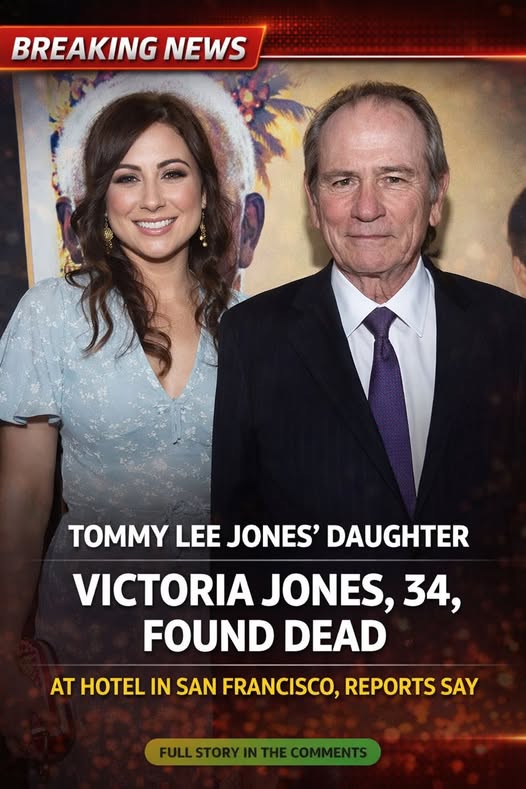

A quiet hotel room in San Francisco has become the center of a deeply unsettling tragedy, sending shockwaves through Hollywood and beyond. According to early reports, a woman believed to be Victoria Jones, the 34-year-old daughter of acclaimed actor Tommy Lee Jones, was found unresponsive in the early hours of the morning. Emergency responders arrived shortly before 3 a.m., but despite their efforts, she was pronounced dead at the scene.
Authorities have stated that no immediate signs of foul play were observed, and the case is being treated as a death pending further medical examination. The official cause has not yet been released by the medical examiner, leaving a painful void where clarity might otherwise offer some measure of closure. In situations like this, uncertainty often compounds grief, transforming shock into something heavier and more disorienting.
For a family that has spent decades under public scrutiny while fiercely protecting its private life, the moment feels especially cruel. Tommy Lee Jones has built a career portraying men of unyielding resolve—figures defined by restraint, grit, and emotional control. Off screen, however, he has always drawn a firm boundary between his professional work and his role as a father. That separation now feels heartbreakingly fragile.
Victoria Jones was never a regular presence in Hollywood headlines, by choice rather than circumstance. She briefly stepped into the cinematic world her father inhabited, appearing in projects such as Men in Black II and The Three Burials of Melquiades Estrada. Those appearances were not launchpads for celebrity, but quiet moments shared between parent and child within a demanding industry. Afterward, she retreated from the spotlight, living largely outside the machinery of fame.
In the aftermath of the reports, photographs from earlier years have resurfaced—father and daughter on red carpets, at film festivals, standing side by side in moments that once seemed routine. Now, those images feel impossibly delicate, frozen reminders of time that can never be reclaimed. The contrast between public success and private vulnerability has rarely felt more stark.
San Francisco officials have emphasized that investigations are ongoing and that speculation should be avoided until all medical findings are complete. Still, in the age of instant news cycles and viral headlines, restraint is often the first casualty. Online commentary has ranged from sympathetic to intrusive, underscoring the uncomfortable reality that even grief can become content when it intersects with celebrity.
Industry colleagues and longtime observers note that Jones has always been intensely private about his family. Unlike many public figures, he rarely discussed his children in interviews, preferring to let his work speak for itself. That discretion now leaves the public with very little to hold onto beyond respect for a man enduring a loss no role could ever prepare him for.
The death of a young adult reverberates differently than any other kind of loss. It disrupts the natural order, raising questions that have no satisfying answers. For parents, it is often described as an unthinkable rupture—one that reshapes identity, memory, and the future itself. No amount of professional achievement can insulate against that kind of pain.
Mental health advocates have also urged caution and compassion, noting that premature conclusions can harm families already navigating trauma. Until official findings are released, what remains most important is space—for truth to emerge, and for loved ones to grieve without added pressure.
For now, there are no public statements from Tommy Lee Jones or his representatives. Silence, in moments like these, is not avoidance but survival. Grief does not unfold on a schedule, and it does not owe explanations to anyone outside its immediate circle.
As the investigation continues, the focus remains on honoring a life rather than sensationalizing its end. Victoria Jones lived largely beyond public view, and that dignity deserves to be preserved. What lingers most powerfully is not how she died, but the reality that she is gone—and that a family known for strength on screen is now facing the most human of losses away from it.