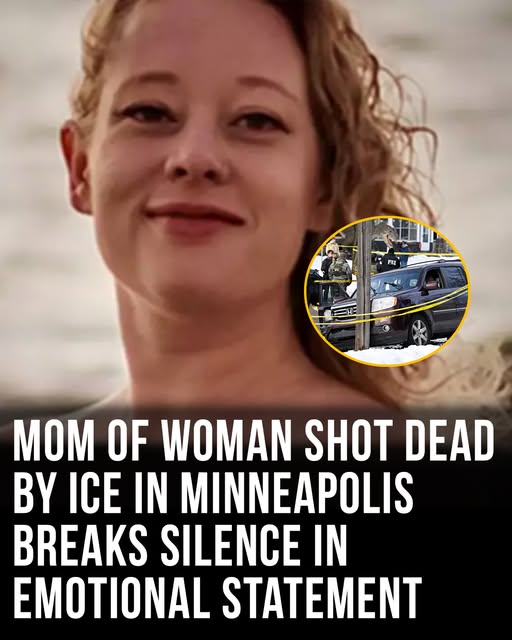

The footage lasts only seconds, but it has altered a family forever and ignited a national reckoning. A woman behind the wheel, panic etched into her movements. A federal agent stepping forward. A gun raised. One shot. By the time the car comes to rest, a mother is dead, a child is orphaned, and a country is once again split between what officials say happened and what millions of people believe they saw with their own eyes.
The woman was Renee Nicole Good, a 37-year-old mother living in Minneapolis. The agency involved was U.S. Immigration and Customs Enforcement. The video, recorded by a bystander, spread faster than any official statement could keep up with. It showed Renee attempting to drive away during a chaotic encounter. Authorities later claimed she “weaponized her vehicle.” Viewers saw something else: a terrified woman trying to escape.
Between those two interpretations lies the space where grief, power, and politics collide.
Renee’s death was not just another headline to the people who knew her. She was a mother, a daughter, a neighbor, a familiar face in her community. Friends described her as careful and soft-spoken, someone who avoided confrontation and focused on raising her children. She wasn’t politically active. She wasn’t looking for a fight. She was trying to get away from something that frightened her.
Her mother, Donna Ganger, has now broken her silence. In an emotional statement, she spoke not as an activist or a spokesperson, but as a parent who buried her child. She described Renee as gentle, protective, and devoted to her kids. She spoke of phone calls that will never come again, of a grandson asking questions she doesn’t know how to answer, and of the unbearable task of defending her daughter’s memory against official language that makes Renee sound like a threat instead of a human being.
According to federal authorities, the agent fired in self-defense. According to the video, Renee’s vehicle was moving away, not toward the agent. The distance between those two claims has become the central fracture in the case. It is a familiar one. Time and again, Americans have watched videos that contradict official narratives, only to hear explanations that seem designed less to clarify the truth than to justify lethal force after the fact.
Minneapolis Mayor Jacob Frey did not mince words. He publicly rejected the self-defense justification, calling the shooting reckless and unnecessary. His response echoed the anger rippling through the city, where protests and vigils have filled streets with candles, posters, and chants demanding accountability. To many residents, this was not about immigration enforcement or legal technicalities. It was about a government agent choosing to pull a trigger when other options clearly existed.
What has cut deepest is the human cost that gets lost in procedural debates. Renee leaves behind a six-year-old son who has now lost both parents. His father died years earlier. In a matter of seconds, the state’s use of force turned a child into an orphan. No investigation timeline, press conference, or legal review can undo that reality.
Donna Ganger has spoken about that child often. She has described the way he clings to familiar objects, the way he asks when his mom is coming home, the way adults struggle to explain something that makes no sense even to them. While politicians argue and agencies release carefully worded statements, a little boy is learning what absence feels like at an age when the world should still feel safe.