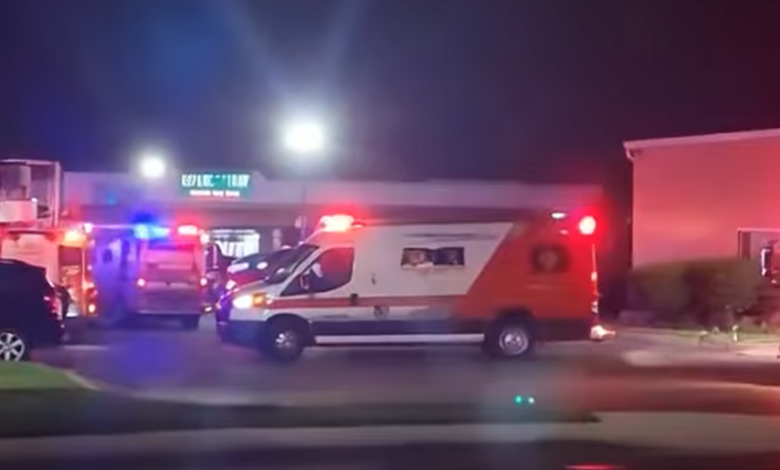

The sun was beginning to dip below the horizon in Stockton, casting long, golden shadows across a residential street that, only hours earlier, had been vibrant with the sounds of a celebration. It was supposed to be a day defined by the milestones of childhood—the sticky sweetness of frosting, the crinkle of wrapping paper, and the high-pitched chorus of a birthday song. Instead, the neighborhood was transformed into a landscape of yellow police tape and the rhythmic, haunting pulse of emergency lights. The tragedy that unfolded during what should have been a sacred rite of passage left four people dead and ten others wounded, carving a permanent scar into the collective heart of the community.
In the immediate aftermath, the scene remains frozen in a grotesque tableau of interrupted joy. The air, thick with the cooling evening breeze, still carries the faint, sugary scent of a birthday cake that was never fully enjoyed. On a folding table draped in a colorful plastic cloth, untouched slices of cake sit neatly on paper plates, abandoned beside dried pools of deep crimson that stain the pavement. Nearby, a discarded party hat lies crushed in the dirt, and stuffed animals—prizes from a game that ended in terror—lie facedown on the grass. These silent witnesses tell the story of a horror that the youngest survivors cannot yet fully comprehend, their innocence having been stripped away in a barrage of sudden, violent noise.
The survivors of the Stockton shooting now move through a world that has become unrecognizable. For the parents who were present, the trauma is a relentless loop of “what ifs.” They sit in the heavy silence of their homes, replaying the split-second decisions that meant the difference between life and death. They wonder if a slightly different position on the porch or a decision to step left instead of right could have altered the trajectory of the day. There is a profound, hollow guilt that accompanies such survival—a heavy weight that settles in the chest and refuses to lift. They look at their surviving children and see a new, jagged fear in their eyes, a realization that the world is not the safe, predictable place they were promised.
The surrounding neighborhood has been gripped by a pervasive, chilling hyper-vigilance. The sense of security that once allowed children to roam between front yards and neighbors to leave their doors unlocked has evaporated. Now, every unfamiliar car that cruises slowly down the block is viewed with intense suspicion. Every distant pop—a car backfiring or a firework in the next street over—causes hearts to race and hands to tremble. The sound of laughter, once the soundtrack of the suburb, has been replaced by a watchful, guarded silence. The community is mourning not just the lives lost, but the loss of their sanctuary.
Stockton officials and law enforcement have mobilized in a desperate pursuit of justice. Detectives move through the scene with clinical precision, combing through digital footprints, scouring doorbell camera footage, and interviewing witnesses whose voices are still thick with shock. They have issued public pleas for information, begging anyone who saw a suspicious vehicle or an unfamiliar face to come forward. There is a fierce, public promise that those responsible will be held accountable, but even the most thorough investigation cannot restore the fundamental truth that was stolen. No courtroom verdict or prison sentence can mend the shattered belief that a child’s birthday is a protected space, or that a home is a refuge from the darkness of the world.
In living rooms across Stockton, the mourning has taken a tangible form. Small, impromptu altars have begun to appear on mantels and coffee tables. Candles flicker beside framed photographs of the victims—faces frozen in moments of happiness that now feel like they belong to a different lifetime. There are the young, whose potential was extinguished before it could even begin to glow, and the adults who died trying to shield them. These flickering lights are the only beacons in a city that is quietly asking a question that seems to have no answer: how many more celebrations must end in the wail of sirens? How many more birthday candles must be replaced by memorial vigils?
The tragedy has reignited a local and national dialogue about the frequency of mass violence in spaces meant for joy. Community leaders and grief counselors have descended on the neighborhood, offering support to families who are now facing a future defined by absence. They speak of resilience and the strength of the Stockton spirit, but for those who lost a parent, a sibling, or a child, those words often feel like thin bandages on a gaping wound. The trauma is not just a personal cross to bear; it is a communal burden. The shooting has become a catalyst for a deeper, more painful introspection about the societal failures that allow such weapons to find their way into a backyard filled with children.
As the days pass, the physical evidence of the shooting will be scrubbed away. The blood will be washed from the driveway, the discarded plates will be thrown out, and the police tape will eventually be taken down. But the psychological debris will remain. The children who survived will carry the memory of that afternoon into adulthood, their milestones forever colored by the shadow of what happened at a simple birthday party. The neighbors will eventually stop jumping at every loud noise, but they will never truly stop watching the street. The community is forever changed, bonded together by a shared history of grief and a collective longing for a time when a birthday was just a birthday.
As the sun sets on another day in Stockton, the city remains in a state of quiet, dignified mourning. The investigations continue, and the legal machinery grinds forward, but the real story is found in the hushed conversations on front porches and the tearful embraces in grocery store aisles. It is a story of a community trying to find its way back to a sense of peace that may never fully return. For now, the focus remains on the families, the memories of the four souls who were taken too soon, and the ten who are fighting to heal both their bodies and their minds. The road to recovery is long, and the scars are deep, but the resolve to protect the sanctity of childhood and the safety of the home remains the one flickering light in the darkness.