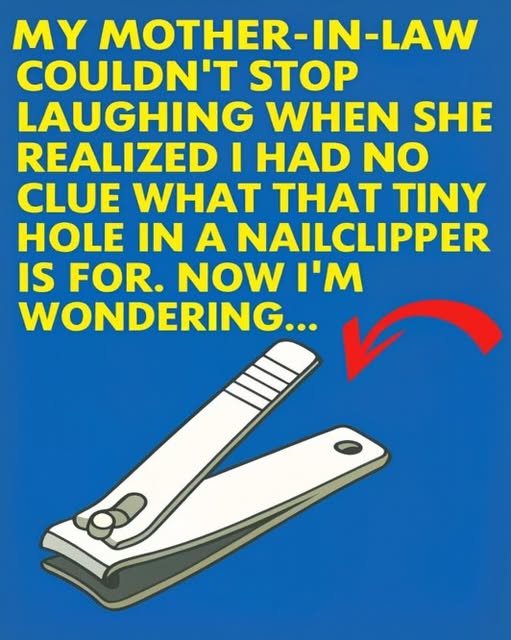

Most people pick up a pair of nail clippers without giving them a second thought. They sit quietly in bathroom drawers, toiletry bags, or pockets, doing their job with little fanfare. Yet if you pause for a moment and really look at one, you’ll notice a small detail that often goes unnoticed: the tiny round hole at the end of one handle. It’s easy to assume it’s decorative or leftover from manufacturing, but that little opening is there for a reason. In fact, it’s one of the most quietly practical features of the entire tool.
Nail clippers are a perfect example of everyday design done right. They are compact, durable, easy to use, and almost universally recognizable. Their basic shape has barely changed over decades, not because designers lacked creativity, but because the form works. Each part has a role, including that small circular hole that many people never question. Understanding why it exists reveals how even the simplest objects are shaped by thoughtful engineering and real-world habits.
The most straightforward purpose of the hole is portability. Nail clippers are small enough to get lost easily. They slip between couch cushions, disappear into cluttered drawers, or vanish into the depths of handbags and backpacks. By adding a small hole, manufacturers made it possible to attach the clipper to a keychain, lanyard, or metal ring. This turns an easy-to-lose object into something that can stay securely attached to items people already keep track of, like keys or travel kits.
For people who are frequently on the move, this feature is especially useful. Travelers often carry nail clippers in carry-on luggage or toiletry pouches, and attaching them to a ring helps prevent them from being misplaced or forgotten in hotel rooms. Students, commuters, and workers who spend long hours away from home also benefit from having basic grooming tools readily available. That tiny hole quietly solves a problem most people don’t even realize they have until the moment they need clippers and can’t find them.
Beyond portability, the hole offers practical advantages at home as well. Many people hang their nail clippers on hooks, bathroom organizers, or inside cabinet doors. This keeps them visible and accessible instead of buried under piles of other items. In shared households, where multiple people use the same bathroom, hanging clippers can reduce clutter and prevent confusion about where they’re stored. It’s a simple solution that improves organization without requiring extra accessories or space.
Some users also discover that the hole improves grip and control. Sliding a finger through the opening can help stabilize the clipper, especially when trimming nails at awkward angles. This can be helpful for people with limited hand strength, arthritis, or reduced dexterity, as it provides an extra point of balance. While nail clippers are generally easy to handle, this small adjustment can make grooming more comfortable and precise, particularly when cutting thicker nails or working carefully around sensitive areas.
The hole also makes it easier to keep multiple clippers together. Many people prefer to use separate clippers for fingernails and toenails for hygiene reasons. Attaching both to the same ring ensures they stay together while still being clearly distinguishable. Families with children may use different clippers for different members, and grouping them with small tags or color-coded rings helps keep things organized. Again, it’s a small feature that quietly supports everyday habits.
This design detail isn’t a modern invention. Nail clippers, in various forms, date back to the late 19th century, when personal grooming tools began to be mass-produced. Early designs already included openings or loops for carrying and storage. At a time when people didn’t have built-in bathroom cabinets or specialized organizers, the ability to hang tools or carry them securely was essential. The hole proved so useful that it became a standard feature, passed down through generations of design without needing reinvention.
What’s striking is how little this feature has changed. Despite advances in materials, manufacturing techniques, and aesthetics, the classic nail clipper remains largely the same. Modern versions may be sleeker, sharper, or made from different alloys, but the small round hole often remains exactly where it’s always been. That consistency speaks to the success of the original design. When something works well, there’s no need to complicate it.
The hole also reflects a broader principle of good design: versatility. A single feature can serve multiple purposes without adding complexity. It doesn’t interfere with the clipper’s primary function, doesn’t make it harder to use, and doesn’t increase cost in any meaningful way. Instead, it quietly adds value, adapting to different lifestyles and preferences. Whether someone uses it for hanging, carrying, gripping, or organizing, the hole meets them where they are.
In a world full of overengineered products, the nail clipper stands out as a reminder that effective design doesn’t have to be flashy. It’s about anticipating real human behavior: people lose small items, they travel, they share spaces, and they appreciate tools that work intuitively. The tiny hole on a nail clipper isn’t there to draw attention. It’s there to solve problems before they become noticeable.
Next time you pick up a pair of clippers, that small circular opening may seem insignificant, but it represents decades of practical thinking distilled into a single detail. It’s proof that even the most ordinary objects can be thoughtfully designed, and that sometimes the smallest features make the biggest difference in daily life.